
Asian buffet catering is one of the easiest ways to feed a group in Bali while still giving guests a sense of “we’re in Asia, not just at any generic party.” Done well, it combines familiar favourites with regional dishes, live cooking stations, and a buffet layout that feels like a proper event—not just food on a table.
This Asian Buffet Setup for Private Events in Bali guide walks through how to design, brief, and execute an Asian‑led buffet for villa parties, weddings, retreats, and corporate events—plus what local caterers in Bali typically include by default.
When an Asian Buffet Makes the Most Sense
Bali catering companies and venues push Asian and Indonesian buffets heavily for:
- Villa birthday parties and celebrations – casual but impressive, easy for guests to serve themselves.
- Wedding receptions and welcome dinners – flexible enough for mixed tastes and dietary needs.
- Corporate events and retreats – long‑table or standing buffets that support mingling and networking.
- Family gatherings and reunions – kid‑friendly options plus deeper flavours for adults.
Examples:
- Tirtha’s Indian Asian Buffet designed for Indian wedding receptions, with live teppanyaki, grill, noodle stations, and dessert tables.
- Bali Catering Company’s “Buffet (Western, BBQ, International, Indonesian)” with sushi, tacos, BBQ, and dessert stations as an interactive experience.
- Indonesian/Asian buffet menus from Bali Chef & Bar and Bali Nights focused on regional flavours, from Balinese dishes to broader Asian favourites.
If you want the experience to clearly signal “Asia” rather than just “international buffet,” you’ll want to lean into Indonesian + regional Asian, then add a few Western comfort items as support.
Core Components of an Asian Buffet Setup
From Bali Chef & Bar, Tirtha, Bali Catering Company, Kaminari, Bali Prime, and other providers, a solid Asian buffet setup usually includes:
- Buffet tables & layout
- Long or L‑shaped tables for mains and sides.
- Separate “islands” for salads, desserts, or live stations (if space allows).
- Chafing dishes & serving gear
- Stainless or clay chafers to keep dishes hot.
- Serving spoons, tongs, ladles, etc. provided by the caterer.
- Asian‑led menu
- A mix of Indonesian, Indian, Japanese, Chinese, or pan‑Asian dishes, depending on your theme.
- Often structured as: salads, appetizers, mains, carbs, condiments, dessert.
- Staff
- Catering staff to set up, replenish the buffet, and clear plates.
- Additional staff for live cooking stations or carving, if included.
- Optional live cooking stations
- Noodle bar, teppanyaki, grills, satay/BBQ, or dim sum stations—common in Indian/Asian wedding buffets and “interactive” buffet concepts.
Most professional caterers in Bali can provide all the hardware: buffet tables, chafers, serving equipment, and basic setup as part of the package, with plates, cutlery, tables, chairs, and decor available as add‑ons.
If you’re still choosing between this and a more intimate chef‑only experience, also see:
Villa Catering vs Private Chef in Bali: What’s the Difference?.
Building the Actual Menu: Asian Buffet Structures That Work
You don’t have to invent your own menu from scratch—Bali caterers already use proven structures you can adapt.
Example 1: Indonesian / Pan‑Indonesian Buffet
Bali Chef & Bar’s Indonesian buffets showcase dishes from across the archipelago, often split into themed menus (Flavors of Indonesia, Indonesian BBQ, Balinese buffet, seafood buffet, veg/vegan/gluten‑free).
Typical structure:
- Salads & sides – urab, gado‑gado, fresh salads, sambals.
- Appetisers – sate (chicken, beef, fish), fritters, small bites.
- Mains – beef rendang, ayam betutu, grilled fish, curries.
- Carbs – nasi putih/nasi kuning, fried rice, noodles.
- Dessert – local sweets, fruit platters, cakes.
Works well when you want the event to feel strongly Indonesian/Balinese.
Example 2: Indian + Asian Fusion Buffet
Tirtha’s Indian Asian Buffet is built around an Indian buffet core, with optional fusion and live stations—teppanyaki, grill, noodles—and separate stalls for extra variety.
Structure:
- Soups and salads.
- Live stations (teppanyaki, grill, noodles).
- Appetisers (chaats, small bites, possibly Asian tapas).
- Mains (curries, tandoor items, Asian stir‑fries).
- Desserts (Indian sweets plus cakes, fresh fruit).
Use this when you expect many Indian guests or want a strong Indian presence in your menu, supplemented by broader Asian options.
Example 3: Japanese / Asian Fusion Buffet
Kaminari’s catering focuses on Japanese and fusion food, offering buffets or seated meals with sushi, Japanese mains, and Western/Asian fusion dishes.
Typical components:
- Sushi & sashimi.
- Japanese salads and sides.
- Live stations (yakitori, teppan, gyoza, etc.).
- Rice, noodles, and mains (teriyaki, katsu, grilled fish).
- Dessert (Japanese‑inspired sweets or international desserts).
Great when you want a more modern, sleek Asian feel (especially for corporate or chic weddings).
Example 4: Mixed Asian + International Buffet
Many companies, including Bali Catering and Bali Nights, position their buffets as a “carnival of flavours” or “not your average Asian food,” mixing Asian dishes with Western comfort food.
Structure:
- Salads (some Asian, some Western).
- Finger foods (spring rolls, satay, sliders, etc.).
- Asian mains (curries, stir‑fries, noodles) plus some Western mains.
- Carbs (rice, breads, noodles).
- Desserts (mix of Asian and Western sweets).
This is useful when your group has mixed tastes and comfort levels with Asian food.
For additional inspiration focused on dishes themselves, you can link to:
Top Asian Dishes Perfect for Private Dining in Bali and
Fusion Asian Dining Experience with a Private Chef in Bali.
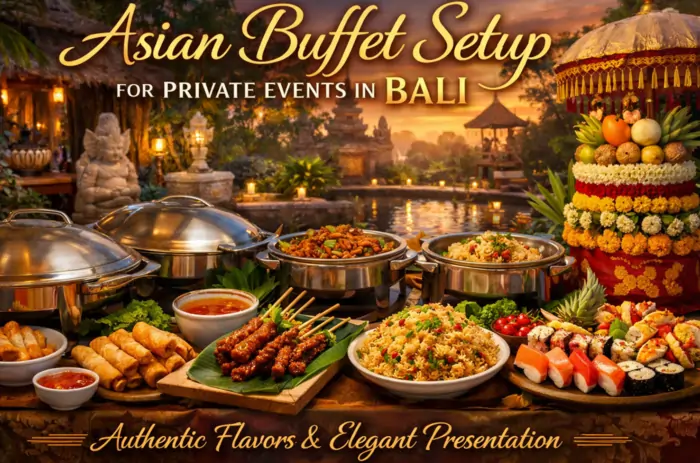
Styling and Decor for an Asian Buffet in a Villa
Instagram and website content from Bali caterers show a clear pattern: buffet setup is part food, part visual theatre.
Common styling elements:
- Buffet presentation
- Multi‑level stands, risers, and varied heights for dishes.
- Traditional or themed serving ware (clay pots for Indonesian dishes, bamboo baskets, etc.).
- Asian visual cues
- Banana leaves, woven trays, batik cloth runners, wooden boards.
- Lanterns, candles, and soft lighting around the buffet tables.
- Event decor tie‑ins
- Colour palette matched to the event (weddings, brands, retreats).
- Signage or small name tags for each dish (helpful for international guests and dietary concerns).
Luxury-oriented caterers like OSA Catering showcase “Luxury Buffet Setup” posts—refined decor, premium dishes, and careful layout—to sell the idea that buffet can be just as elegant as plated dining.
If you’re working with a villa as the venue, you can:
- Ask the caterer which decor elements are included vs extra.
- Check if the villa has its own tables/cloths you can re‑use.
- Decide whether you need additional styling (e.g., for weddings or brand events) via a planner or decorator.
This connects neatly with:
Villa Catering vs Private Chef in Bali: What’s the Difference? and
Private Chef in Bali for Birthday Parties & Celebrations.
How Many Guests? Buffet Setup by Group Size
Bali Chef & Bar lays out how their physical setup changes by guest count:
- 6–14 adult guests
- More “family‑style” serving, ceramic dishes on the dining table with serving equipment.
- 15–30 adult guests
- Buffet tables with clay earthenware chafing dishes and serving equipment; traditional Balinese buffet presentation.
- 30+ adult guests
- Full buffet tables with stainless steel chafers, serving equipment, and classic white dinnerware and cutlery.
Other caterers follow similar scaling logic: the bigger the group, the more you move from family‑style and simple setups to full buffet infrastructure with clearly defined stations and flows.
If you’re planning:
- Under 15 guests – you can blur the line between private chef and buffet (family‑style Asian spread).
- 15–40 guests – a proper buffet with one or two lines is ideal.
- 40+ guests – plan for multiple lines/stations to avoid bottlenecks.
For group/event positioning, also see:
Private Chef in Bali for Birthday Parties & Celebrations and
Hiring a Private Chef in Bali for Corporate Retreats.
Dietary Requirements and “Inclusive” Asian Buffets
One advantage of Asian buffets is how flexible they can be for dietary needs—if they’re designed that way.
Bali Chef & Bar, Bali Catering, and Indian/Asian caterers highlight:
- Dedicated vegan/vegetarian/gluten‑free menus or sections.
- Buffets designed as “inclusive menus” with options for no nuts, no egg, vegan, vegetarian, pescatarian, omnivore, and gluten‑free guests all in one spread.
- Clearly labelled dishes to help guests navigate.
When you brief your caterer, send a structured list:
- Number of guests.
- Number of vegans, vegetarians, gluten‑free, halal, etc.
- Any specific allergies (nuts, shellfish, etc.).
Ask specifically:
- “Can you design an Asian buffet that is inclusive of [list] without feeling like compromise?”
- “Can you provide dish labels noting dietary tags (V, GF, contains nuts, etc.)?”
If your event is Asia‑positioned (e.g., brand doing an “Asian villa experience”), also connect with:
Asian Private Chef in Bali: Why Choose Asian Cuisine for Your Event.
Costs and What’s Typically Included
Pricing will vary by provider and menu, but Asian buffets in Bali are usually priced per person, with inclusions scaling by headcount.
From Bali Chef & Bar, Bali Catering Company, and similar services:
Typically included in buffet price:
- Food and menu design.
- Catering kitchen team and on‑site cooking (or finishing).
- Buffet tables and configuration appropriate to guest count.
- Chafing dishes, serving bowls, platters, and serving utensils.
Common add‑ons (extra cost):
- Plates, cutlery, glassware (sometimes included at higher guest counts).
- Dining tables, chairs, tablecloths.
- Decor (flowers, candles, runners, theming).
- Bar and drinks packages (bartenders, cocktails, wine service).
- Entertainment (DJ, band, dancers).
Because pricing structures change, it’s smart to:
- Ask for package pricing based on your headcount and menu type (Indonesian, Indian/Asian, Japanese, mixed Asian).
- Clarify exactly what is included in the per‑person rate vs rental and decor fees.
For overall cost context of in‑villa F&B, you can cross‑reference:
How Much Does a Private Chef Cost in Bali? (2026 Price Guide) and
Villa Catering vs Private Chef in Bali: What’s the Difference?.
How to Brief a Caterer for an Asian Buffet in Bali
When you reach out to a villa catering company or event caterer for an Asian Buffet Setup for Private Events in Bali, include:
- Event type & vibe:
- “Villa birthday party,” “wedding welcome dinner,” “corporate retreat closing night,” etc.
- Guest count & profile:
- Adults, kids, local vs international guests.
- Date, time, & venue:
- Bali villa name/location, desired service times, indoor vs outdoor.
- Menu direction:
- Indonesian‑led vs Indian‑Asian vs Japanese/fusion vs mixed Asian.
- Dietary considerations:
- Number of vegans/vegetarians, halal, gluten‑free, allergies.
- Budget range:
- Per person or total F&B budget.
Sample brief line:
“We’re looking for an Asian buffet setup in our villa for [X] guests, with a strong Indonesian + wider Asian feel, inclusive of vegans and gluten‑free. We’d like buffet tables, chafers, staff, and basic setup included, with decor and bar quoted as options.”
This aligns with how Bali catering and buffet providers ask clients to “choose your package, share your event details, and receive a tailored quote.”
For event‑level planning alongside the buffet, also see:
Private Chef in Bali for Birthday Parties & Celebrations and
Hiring a Private Chef in Bali for Corporate Retreats.
Final Thoughts: Making “Buffet” Feel Like a Feature, Not a Compromise
A well‑designed Asian buffet setup for private events in Bali isn’t the cheap option in the corner—it’s the centrepiece of your party:
- Guests see abundant, colourful food that clearly reflects where they are.
- Live or interactive elements (stations, carving, wok/teppan) keep things dynamic.
- Dietary‑inclusive design ensures everyone can eat confidently without separate plates.
Use this guide to:
- Decide what type of Asian buffet suits your event.
- Understand what Bali caterers usually include and where you might need extras.
- Brief your caterer clearly so they can deliver a buffet that feels on‑brand for your event and for Bali itself.
Then tie it back into your wider F&B strategy with:
- Villa Catering vs Private Chef in Bali: What’s the Difference?
- Private Chef in Bali for Birthday Parties & Celebrations
- Hiring a Private Chef in Bali for Corporate Retreats
With those pieces, your Asian buffet becomes an intentional, high‑impact part of the event—not an afterthought.
