
Someone with a thyroid nodule should see a head and neck surgeon if the nodule is growing, causes hoarseness or difficulty swallowing, feels hard or fixed to surrounding tissue, or is associated with enlarged lymph nodes in the neck.
A head and neck surgeon reviews your GP referral and medical history, performs a thorough neck examination, may perform nasendoscopy to check vocal cords, reviews any ultrasound or CT scans, explains findings clearly, and discusses treatment or surgical options. A GP referral is required before seeing a specialist in Australia.
Disclaimer: This information is for educational purposes only and does not replace professional medical advice. Always consult a registered health practitioner for any thyroid or neck concern. Do not delay seeking care based on something you have read here. In an emergency, go to a hospital.
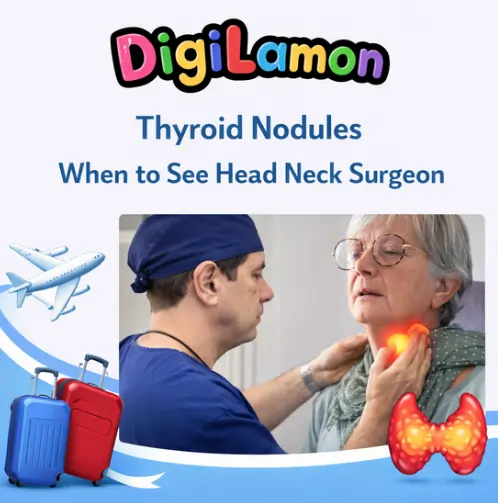
Table of Contents
What Is a Thyroid Nodule?
A thyroid nodule is a lump that forms within the thyroid gland. The thyroid gland is located in the front of the neck, just below the Adam’s apple. It produces hormones that control metabolism, heart rate, body temperature, and energy levels.
Types of thyroid nodules:
| Type | Description |
|---|---|
| Solitary nodule | A single lump |
| Multiple nodules | Two or more lumps |
| Cystic nodule | Filled with fluid |
| Solid nodule | Made of solid tissue |
| Complex nodule | Both solid and cystic components |
How thyroid nodules are found:
- You or your doctor feels a lump in your neck
- Discovered during a routine physical examination
- Seen on an ultrasound, CT scan, or MRI done for another reason
- Found during a thyroid ultrasound ordered for other symptoms
In Australia, patients with a thyroid nodule can be referred by a GP to a head and neck surgeon such as Dr. Brett Leavers, who practices at multiple locations in Sydney and regional NSW.
How Common Are Thyroid Nodules?
Thyroid nodules are extremely common.
| Statistic | Percentage |
|---|---|
| People with at least one thyroid nodule by age 60 | Up to 50% |
| Thyroid nodules that are cancerous | Only 5-10% |
| More common in women than men | Yes |
| Risk increases with age | Yes |
Most people with thyroid nodules live normal, healthy lives without any treatment. However, proper evaluation by a head and neck surgeon is important to rule out cancer and monitor for changes.
Most Thyroid Nodules Are Benign
This is the most important fact to remember.
Benign means:
- Not cancerous
- Does not spread to other parts of the body
- Usually does not require surgery
- May only need periodic monitoring
Why benign thyroid nodules still need evaluation:
- Some can grow over time
- Large nodules can cause pressure symptoms
- Rarely, benign nodules can become cancerous
- Monitoring establishes a baseline for future comparison
A head and neck surgeon like Dr. Brett Leavers can perform a thorough examination to determine what a thyroid nodule is and whether it needs treatment.
Symptoms of Thyroid Nodules
Most thyroid nodules cause no symptoms at all.
Symptoms that may occur with larger thyroid nodules:
| Symptom | Description |
|---|---|
| Visible lump | Swelling in the front of the neck |
| Fullness or pressure | Feeling of something in the neck |
| Hoarseness | Voice changes |
| Difficulty swallowing | Dysphagia |
| Difficulty breathing | With very large nodules |
| Neck pain | Tenderness over the nodule |
Symptoms of thyroid hormone imbalance (toxic nodules):
- Weight loss
- Rapid heartbeat
- Anxiety
- Heat intolerance
If you have any of these symptoms with a thyroid nodule, see a GP for a referral to a head and neck surgeon like Dr. Brett Leavers for evaluation.
When to See a Head and Neck Surgeon
Not every thyroid nodule needs a surgeon. But some do.
See a head and neck surgeon immediately if:
| Red Flag Symptom | Action |
|---|---|
| Nodule is growing rapidly | Seek referral promptly |
| Hoarseness that does not improve | See a GP for ENT referral |
| Difficulty swallowing | Urgent evaluation needed |
| Hard or fixed lump in the neck | See a GP within days |
| Enlarged lymph nodes in the neck | Requires assessment |
| Family history of thyroid cancer | Mention to your GP |
| Childhood neck radiation exposure | Mention to your GP |
See a head and neck surgeon for evaluation if:
- A thyroid nodule was found on imaging
- Your GP recommends a specialist consultation
- You want a second opinion about your nodule
- You have symptoms even if imaging is normal
Dr. Brett Leavers is a head and neck surgeon who can assess thyroid nodules and recommend appropriate next steps.
What Happens During a Head and Neck Surgery Consultation
If a GP refers you to a head and neck surgeon for a thyroid nodule, a typical consultation includes:
| Step | What Happens |
|---|---|
| 1 | Review of your GP referral and medical history |
| 2 | Thorough examination of the neck (feeling the thyroid, nodule, and lymph nodes) |
| 3 | Oral cavity assessment (tongue, tonsils, floor of mouth) |
| 4 | Nasendoscopy if required (camera through nose to view vocal cords) |
| 5 | Review of any ultrasound, CT, or MRI scans |
| 6 | Clear explanation of findings |
| 7 | Treatment planning or surgical discussion |
What to bring: GP referral, ID, medication list, symptom summary, any previous scans or test results.
Dr. Brett Leavers is a head and neck surgeon who performs these consultations at multiple locations across Sydney and regional NSW (see addresses below).
Diagnostic Tests for Thyroid Nodules
A head and neck surgeon may recommend several tests to evaluate a thyroid nodule.
| Test | Purpose |
|---|---|
| Thyroid ultrasound | Shows size, shape, composition; identifies concerning features; guides biopsy |
| Thyroid function blood tests | Measures TSH, T3, T4; checks if nodule produces excess hormone |
| Fine needle aspiration biopsy | Thin needle collects cells; most accurate way to diagnose thyroid cancer |
| CT or MRI scan | Used for large nodules or those extending into the chest; helps plan surgery |
The Bethesda system is used to report fine needle aspiration results, ranging from non-diagnostic to malignant.
Treatment Options for Thyroid Nodules
Treatment depends on the type of thyroid nodule, its size, and whether it is causing symptoms.
| Option | Indication |
|---|---|
| Monitoring (watchful waiting) | Benign nodules with no concerning features; repeat ultrasound in 12-24 months |
| Thyroid hormone suppression therapy | May slow nodule growth; not always effective |
| Surgery (thyroidectomy) | Cancerous nodules, large nodules causing symptoms, growing nodules |
| Radiofrequency ablation | Minimally invasive for benign nodules; uses heat to shrink |
A head and neck surgeon like Dr. Brett Leavers will explain the risks and benefits of each option for your specific thyroid nodule.
When Is Thyroid Surgery Needed?
Thyroid surgery (thyroidectomy) is not always necessary for a thyroid nodule.
Reasons for thyroid surgery:
| Indication | Explanation |
|---|---|
| Cancerous or suspicious nodule | Requires surgical removal |
| Nodule causing hoarseness | Affecting recurrent laryngeal nerve |
| Nodule causing difficulty swallowing | Compressing the oesophagus |
| Nodule causing breathing problems | Compressing the trachea |
| Nodule growing on monitoring | Change over time |
| Very large nodule (over 4 cm) | Size alone may indicate surgery |
| Patient preference | After discussing risks and benefits |
Types of thyroid surgery:
- Lobectomy: Removal of half the thyroid gland
- Total thyroidectomy: Removal of the entire thyroid gland
- Isthmusectomy: Removal of the central part of the thyroid
Dr. Brett Leavers is a head and neck surgeon experienced in thyroid surgery. He will only recommend surgery if it is truly necessary for your thyroid nodule.
Dr. Brett Leavers – Head and Neck Surgeon (Sydney & NSW)
Dr. Brett Leavers is a head and neck surgeon who consults at multiple locations in Sydney and regional NSW. Patients with thyroid nodules can be referred to his practice by a GP.
| Location | Address |
|---|---|
| Darlinghurst | St Vincent’s Clinic, Suite 1008, Level 10, 438 Victoria St, Darlinghurst NSW 2010 |
| Rozelle | Sydney Specialist Suites, 670B Darling St, Rozelle NSW 2039 |
| Kogarah | St George Private Hospital, Suite 14, level 4, 1 South St, Kogarah NSW 2217 |
| Denistone (Eastwood) | 52 Denistone Road, Eastwood NSW 2122 |
| Griffith | St Vincent’s Private Community Hospital, 41-45 Animoo Avenue, Griffith NSW 2680 |
His head and neck surgery expertise includes:
- Thyroid nodules, goitre, or thyroid enlargement
- Neck lumps or unexplained neck swelling
- Salivary gland issues (parotid or submandibular swelling)
- Enlarged or persistent lymph nodes
- Throat or neck fullness that does not resolve
- Hoarseness associated with neck or throat symptoms
- Suspicious, persistent, or changing neck masses
Important notes:
- A valid GP referral is required before booking an appointment with Dr. Brett Leavers.
- Call reception to confirm availability and current consultation fees.
- This information is not for emergencies. In an emergency, go to a hospital or call 000.
How to Get a GP Referral for a Thyroid Nodule as a Traveler
In Australia, you need a GP referral to see a head and neck surgeon like Dr. Brett Leavers. Telehealth makes this possible while traveling.
Steps to get a referral via telehealth:
| Step | Action |
|---|---|
| 1 | Choose a registered telehealth service (e.g., InstantScripts, Qoctor, or your usual GP’s telehealth option) |
| 2 | Book a video or phone consultation (usually 10–15 minutes) |
| 3 | Tell the GP about your thyroid nodule or neck lump |
| 4 | Describe when you first noticed it and any changes |
| 5 | Ask for a referral to a head and neck surgeon |
| 6 | Receive your referral by email (usually within minutes to hours) |
Note: Telehealth GPs cannot examine your neck physically. They will refer based on your described symptoms. For urgent issues, an in-person GP visit is preferable.
Frequently Asked Questions
1. What is a thyroid nodule?
A thyroid nodule is a lump that forms within the thyroid gland in the front of the neck.
2. Are most thyroid nodules cancerous?
No, only about 5 to 10 percent of thyroid nodules are cancerous. The vast majority are benign.
3. How common are thyroid nodules?
Up to 50 percent of people have at least one thyroid nodule by age 60.
4. What are the symptoms of a thyroid nodule?
Most thyroid nodules cause no symptoms. Large nodules may cause a visible lump, hoarseness, or difficulty swallowing.
5. When should I see a head and neck surgeon for a thyroid nodule?
See a head and neck surgeon if the thyroid nodule is growing, causes hoarseness, feels hard, or is associated with enlarged lymph nodes.
6. Can I see a head and neck surgeon in Sydney without a referral?
No. In Australia, you must have a valid GP referral to see any head and neck surgeon or ENT specialist, including Dr. Brett Leavers.
7. How do I get a GP referral as a traveler in Australia?
Use a registered telehealth service for an online consultation. Ask for a referral to a head and neck surgeon such as Dr. Brett Leavers.
8. How much does a head and neck consultation cost in Sydney?
Private ENT consultations typically cost between AUD $200 and $350. Contact Dr. Brett Leavers‘ clinic for current fees.
9. Where are Dr. Brett Leavers’ clinic locations?
His clinics are in Darlinghurst, Kogarah, Rozelle, Denistone (Eastwood), and Griffith.
10. What is a thyroid ultrasound?
A thyroid ultrasound is an imaging test that shows the size, shape, and features of a thyroid nodule.
11. What is a fine needle aspiration biopsy?
A fine needle biopsy collects cells from a thyroid nodule to check for cancer. It is performed under ultrasound guidance.
12. Is fine needle aspiration painful?
Most people feel only mild discomfort, similar to a blood test. Local anaesthetic may be used.
13. Do all thyroid nodules need biopsy?
No. Only thyroid nodules with concerning features on ultrasound need biopsy.
14. What happens if a thyroid nodule is benign?
Benign thyroid nodules usually only need monitoring with repeat ultrasounds every 12-24 months.
15. What is a goitre?
A goitre is an enlargement of the entire thyroid gland, not just a single thyroid nodule.
16. Can thyroid nodules cause voice changes?
Yes, large thyroid nodules can affect the recurrent laryngeal nerve and cause hoarseness.
17. What is nasendoscopy?
Nasendoscopy is a small flexible camera inserted through the nose to view the throat and vocal cords. A head and neck surgeon may use this to assess thyroid nodules.
18. Does thyroid surgery remove the whole gland?
Sometimes only half the thyroid is removed (lobectomy). It depends on the thyroid nodule and diagnosis.
19. Can I live without a thyroid?
Yes, but you would need lifelong thyroid hormone replacement medication after total thyroidectomy for a thyroid nodule.
20. What is the difference between a GP and a head and neck surgeon?
A GP can order initial tests for a thyroid nodule. A head and neck surgeon like Dr. Brett Leavers has advanced training in thyroid surgery and neck lump evaluation. A GP referral is required.
Thyroid Nodules – When to Seek Care
| Question | Answer |
|---|---|
| What is a thyroid nodule? | A lump within the thyroid gland |
| How common? | Up to 50% of people by age 60 |
| Are most cancerous? | No, only 5-10% |
| Common symptoms? | Usually none. Large nodules may cause lump, hoarseness, or swallowing difficulty |
| When to see a head and neck surgeon? | Growing nodule, hoarseness, hard lump, enlarged lymph nodes |
| Diagnostic tests? | Ultrasound, blood tests, fine needle biopsy |
| Treatment options? | Monitoring, medication, or surgery |
| Surgery needed? | Only for cancerous nodules or those causing symptoms |
For assessment of thyroid nodules, a GP referral to a head and neck surgeon such as Dr. Brett Leavers is required in Australia.
