
Custom Asian Tasting Menu for Private Villa Dining.
A custom Asian tasting menu in your Bali villa is what happens when you combine fine‑dining structure (multiple plated courses, pacing, storytelling) with the flavours and comfort of Asian cuisine. Instead of choosing from a fixed restaurant menu, you and your chef design a sequence that fits your tastes, your guests, and your villa setting.
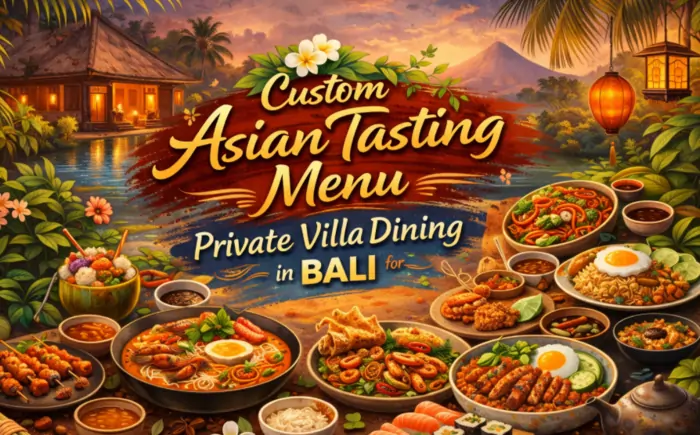
This guide explains how Custom Asian Tasting Menu for Private Villa Dining in Bali works in practice—what it looks like with a chef like Juan Gadi, how many courses to choose, what kinds of dishes fit well, and where the price usually lands.
Why Do a Custom Asian Tasting Menu (Not Just “Dinner”)?
Restaurant and villa content around Bali shows a clear trend: tasting menus are the go‑to format when you want a night to feel special and curated.
Key reasons:
- Narrative and progression
You’re not just eating random plates—you move from lighter, brighter flavours into deeper, richer ones, with a clear beginning, middle, and end. - Balanced variety without chaos
A multi‑course menu lets you try many flavours (seafood, meat, vegetables, rice elements) without the table being overloaded or the meal feeling unfocused. - Perfect for small groups and special occasions
Honeymoons, anniversaries, executive dinners, and “hero nights” in retreats often call for something more structured than family‑style sharing.
Chef Juan’s own positioning on DigiLamon and his site makes this explicit: he designs structured degustation menus and premium multi‑course dining for guests who want executive‑level private dining in their villa.
If you only want one “fancy night” in Bali but prefer Asian flavours over European, a custom Asian tasting menu is the best of both worlds.
How a Chef Like Juan Designs a Custom Asian Tasting Menu
DigiLamon’s profile of Juan shows his menu design process starts as a conversation, not a fixed list:
He asks about:
- Allergies and intolerances (shellfish, nuts, gluten, dairy).
- Preferences (no pork, no beef, pescatarian only, etc.).
- Lifestyle choices (vegan, vegetarian, low‑carb, high‑protein).
- Spice tolerance and flavour profile (mild, moderate, spicy; more Filipino, more Indonesian, or fusion).
From there he:
- Builds a course structure (typically 5–7 courses for gourmet tasting menus).
- Weaves in Asian elements—Filipino, Indonesian/Balinese, pan‑Asian, fusion—using Bali’s produce.
- Adjusts plating, portion sizes, and pacing to suit your group and setting (poolside, terrace, dining room).
This mirrors how high‑end restaurants in Bali build their tasting menus (8–10 courses, local‑leaning Heritage/Pure Local menus, etc.), but with the advantage that your villa and your preferences define the frame.
For background on his style and philosophy:
Private Chef in Bali – Asian Villa Dining Experience by Chef Juan Gadi.
Typical Course Flow for an Asian Tasting Menu in a Bali Villa
You can shape the structure, but a common 5–7 course Asian‑led flow might look like:
- Amuse‑bouche / Welcome Bite
Small Balinese or Filipino‑inspired bite to open the palate (e.g., mini satay lilit, tuna cone, or a tiny adobo‑inspired spoon). - Cold or Fresh Starter
Something acid‑forward and light, like:- Tuna / fish crudo with Asian citrus and herbs.
- Thai‑style or Vietnamese‑inspired salad.
- Japanese‑leaning tuna “stack” on sushi rice (seen on villa menus).
- Soup or Warm Starter
A refined take on:- Soto ayam broth,
- A Filipino or Indonesian soup, or
- A small noodle or dumpling dish in a delicate broth.
- Fish / Seafood Course
Examples: banana‑leaf‑grilled fish (pepes), seared local fish with sambal matah, or a Filipino/Balinese seafood dish re‑plated for tasting menu service. - Main Protein (Meat or Plant-Based)
- Short ribs with Asian glaze and coconut rice.
- A deconstructed take on babi guling elements (for non‑halal groups).
- Rich vegetable curry or tempe/tofu dish for plant‑based menus.
- Pre‑Dessert / Palate Cleanser
A small, refreshing bite: sorbet, granita, or fruit‑forward mini course. - Dessert with Asian Notes
- Coconut, pandan, tropical fruit, or Filipino/Balinese dessert references.
- Something that feels modern but clearly rooted in the region.
Resorts and villa menus in Bali show similar flows for fine‑dining and private dining, combining local ingredients with globally informed plating.
For dish‑level inspiration, cross‑link this page with:
Top Asian Dishes Perfect for Private Dining in Bali.
When a Custom Asian Tasting Menu Is the Best Choice
From DigiLamon’s and Juan’s materials, plus villa/fine‑dining references, this format makes the most sense when:
- You’re celebrating something
Honeymoon, anniversary, milestone birthday, proposal, or a key retreat night. - You want a “hero dinner” in your itinerary
One night that feels clearly different from the rest—multi‑course, slow, and centred around the table. - You or your guests actually enjoy tasting menu pacing
Sitting down for 2–3 hours, with conversation and pauses between courses, not just casual grazing. - You love Asian flavours more than classic French or Italian fine dining
You want rice, umami, and Asian spice logic built into the menu, not just tacked on.
DigiLamon’s honeymoon and romantic guides explicitly recommend multi‑course menus for couples who want a “restaurant‑level experience in the villa,” and Juan’s pricing table calls out Gourmet Tasting Menu (5–7 courses) for honeymoons, anniversaries, and special occasions.
For romance-specific context, see:
Romantic Private Dinner in Bali: The Ultimate Villa Experience and
Best Private Chef Experience in Bali for Honeymoon Couples.
Pricing & How It Compares to Restaurant Tasting Menus
DigiLamon’s Juan guide and Bali fine‑dining write‑ups give a good sense of the range:
- Gourmet Tasting Menu (5–7 courses) with a private chef
- Restaurant tasting menus in Bali
- Many modern tasting menus start around IDR 350.000 – 1.500.000 per person, with top chef multi‑course experiences at the upper end.
When you book a private chef, you’re paying not only for the food but for:
- Menu design tailored to your preferences.
- Ingredient sourcing for your specific menu.
- In‑villa cooking, service, and cleanup.
For full price breakdowns and comparisons, link this article to:
How Much Does a Private Chef Cost in Bali? (2026 Price Guide) and
Private Chef vs Restaurant Dining in Bali: Which Is Better?.
How to Brief Your Chef for a Custom Asian Tasting Menu
To turn Custom Asian Tasting Menu for Private Villa Dining in Bali into a real booking, your message should cover:
- Who & what
- Number of guests, occasion (honeymoon, anniversary, birthday, retreat, executive dinner).
- Cuisine direction
- “Mostly Indonesian/Balinese,” “Filipino‑leaning,” “pan‑Asian fusion,” or “modern Asian with local ingredients.”
- Dietary & spice profile
- Allergies, no‑go ingredients, vegetarian/vegan counts.
- Spice tolerance and any specific dislikes.
- Course count & budget
- 5, 6, or 7 courses, and your rough budget per person, referencing Juan’s tasting menu band if you’re speaking to him.
Example:
“We’d like a 6‑course Asian tasting menu in our villa in Canggu for our anniversary. We love Indonesian and Filipino flavours, eat everything except shellfish, and prefer moderate spice. Our budget is around IDR X per person. Could you propose a menu built around seafood, one richer meat course, and a light dessert?”
For the booking process itself, connect here:
- How to Book a Private Chef in Bali for Your Villa
- What’s Included When You Hire a Private Chef in Bali?.
Final Thoughts: Making Asian Flavours the Star of Your “Fancy Night”
A Custom Asian Tasting Menu for Private Villa Dining in Bali turns your villa into a fine‑dining restaurant for a night—except the flavours aren’t generic European, they’re built for people who actually like eating in Asia.
Use this guide to:
- Decide if tasting‑menu format fits your occasion and group.
- Shape the structure (courses, pacing, flavour direction).
- Brief a chef like Juan Gadi so they can design something that feels both high‑end and deeply comfortable.
Then plug it into your broader Asian and private‑chef content cluster:
- Asian Private Chef in Bali: Why Choose Asian Cuisine for Your Event
- Filipino Chef in Bali: Bringing Asian Flavors to Your Villa
- Fusion Asian Dining Experience with a Private Chef in Bali
Together, they show how to move from “we should do a fancy dinner in Bali” to a clearly defined, Asian‑driven tasting menu in your own villa.
