
A Fusion Asian dining experience in your Bali villa is what happens when a chef takes flavours from across Asia—Indonesian, Filipino, Thai, Japanese, Chinese, and beyond—and recomposes them into a modern, multi‑course story that still feels comforting and familiar.
Instead of choosing between “local” and “Western,” you get both, on your terms, in your own private space.
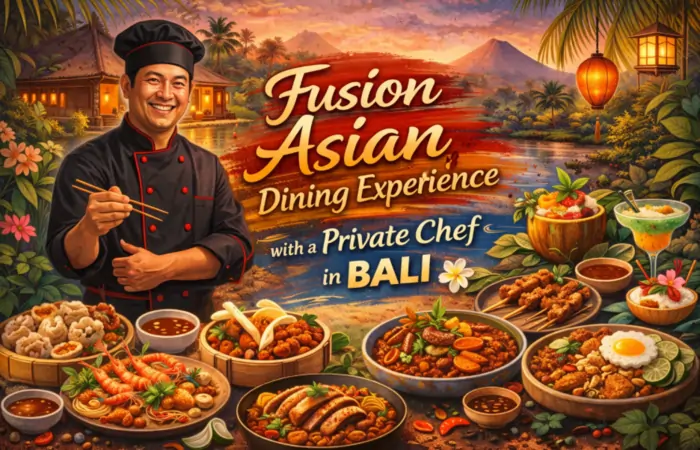
This guide shows how Fusion Asian Dining Experience with a Private Chef in Bali works in practice, how chefs like Juan Gadi think about fusion, and how to use it for romantic dinners, group feasts, and retreat or event nights.
What “Fusion Asian Dining” Actually Means in a Bali Villa
In Bali’s restaurant scene, “modern Asian” and “Asian fusion” usually mean traditional street‑food flavours reworked with contemporary techniques and presentation. Inside a villa, the same idea becomes more personal and tailored:
- Asian flavours, modern structure
Instead of serving sate or rendang exactly as in a warung, a private chef might express those flavours as canapés, components of a plated main, or reimagined sauces and sides. - Local ingredients + regional influences
Villas and high‑end resorts highlight how chefs use Bali’s seafood, herbs, and tropical fruit with Japanese, Thai, Chinese, or Filipino techniques and seasoning logic. - Comfort plus sophistication
You still recognise the flavour DNA—soy, ginger, garlic, lime, sambal, coconut, rice—but the pacing and plating feel like private fine dining rather than casual takeout.
Villa cuisine pages (Villa Vedas, Villa Asta, Villa Lulito, and others) show this clearly: menus mix Balinese and wider Asian dishes with contemporary Western touches, designed for private dining and events rather than everyday restaurant service.
Why Fusion Asian Works So Well for Private Villa Dining
Villa and private‑chef content points to a few reasons Fusion Asian is such a good fit in Bali:
- Great for mixed‑taste groups
Some guests want “real Asian”; others prefer safer, more familiar flavours. Fusion menus let you move between adventurous and comforting in one coherent sequence. - Aligned with Bali’s atmosphere
Tropical produce, poolside dining, and warm evenings pair naturally with bright, layered Asian flavours—fresh herbs, citrus, chillies, and umami—more than heavy European sauces. - Flexible service styles
Fusion Asian works as a plated tasting menu, long‑table sharing feast, or semi‑formal event dinner for birthdays, weddings, and retreats.
Villa Vedas, for example, showcases Asian and fusion dishes (Thai beef salads, Asian mains, noodle and rice dishes) for private weddings and events, while other villas in Seminyak and Canggu mention Asian‑inspired menus created by in‑house chefs for private groups.
If you’d like the broader argument for choosing Asian‑led menus, also see:
Asian Private Chef in Bali: Why Choose Asian Cuisine for Your Event.
How a Chef Like Juan Gadi Approaches Fusion Asian
On DigiLamon and his own site, Chef Juan Gadi is described as a Filipino‑trained executive chef and co‑founder of Kilig Filipino Warung, who now brings that Asian‑first perspective into private villa dining.
His approach to fusion is context‑first:
- Listen before designing
Juan doesn’t start from a fixed “signature menu.” He asks who the guests are, what the occasion is, and what flavour direction (more Filipino, more Indonesian, pan‑Asian, or modern Asian) makes sense for that night. - Blend Filipino and Indonesian roots with broader Asia
He works with Filipino comfort (adobo logic, sinigang sourness, grilled meats), Balinese and Indonesian staples (sambal, pepes, satay), and techniques or ideas from Japanese, Thai, Chinese, and Western kitchens. - Keep clarity over gimmicks
His chef bio emphasises food that fits the guests and setting rather than fusion “for performance.” Cuisine can range from relaxed comfort to refined tasting menus, depending on context.
This matches the best modern Asian restaurants and villa catering collaborations in Bali, where chefs use fusion to clarify flavours and stories, not to make dishes confusing.
For more on his background and villa work, see:
Private Chef in Bali – Asian Villa Dining Experience by Chef Juan Gadi and
Best Private Chef in Bali: Hire Chef Juan Gadi.
Example Fusion Asian Formats You Can Do in Your Villa
These are patterns you can discuss with your chef rather than rigid menus.
1. Fusion Asian Tasting Dinner for Couples (5–7 Courses)
Perfect for honeymoons, anniversaries, or proposals when you want a clear “hero night.”
Possible flow:
- Amuse‑bouche – one bite that nods to satay, adobo, or sambal in a modern form.
- Cold starter – Japanese‑leaning tuna or salmon dish with Southeast Asian herbs.
- Soup / warm starter – a refined broth referencing soto, sinigang, or another regional soup.
- Seafood course – local fish or prawns with Thai‑Balinese seasoning and textural garnish.
- Main protein – short ribs, pork, or plant‑forward main with Filipino/Indonesian flavours and modern plating.
- Pre‑dessert + dessert – light citrus/herb palate cleanser, followed by a coconut/pandan/tropical fruit dessert rooted in Asian flavours.
This is very similar to the multi‑course romantic villa dinners recommended in Bali fine‑dining and honeymoon guides, but with Asian rather than European flavour centres.
You can tie this directly to:
Romantic Private Dinner in Bali: The Ultimate Villa Experience and
Best Private Chef Experience in Bali for Honeymoon Couples.
2. Fusion Asian Sharing Feast for Friends & Family
For 6–12 guests, a sharing-style fusion feast can feel upscale but relaxed.
Typical components:
- Starters to share: dumplings, satays, Asian salads, small fusion bites.
- Mains: mix of Asian‑inspired proteins (short ribs, whole fish, grilled meats) and vegetable dishes.
- Carbs: rice and noodles that reflect Indonesian + wider Asian influences.
- One or two “showstopper” dishes (e.g., a whole fish or roasted meat) in the middle.
This mirrors the “homecooked Balinese” and Asian fusion dinners described by villa chefs in Bali, adapted to your group’s tastes.
Connect this use case to:
Private Chef in Bali for Birthday Parties & Celebrations and
Top Asian Dishes Perfect for Private Dining in Bali.
3. Fusion Asian Event or Retreat Dinner
For larger groups, Fusion Asian works well as:
- Fusion buffet – Thai salads, Asian mains, rice and noodle dishes, plus modern desserts.
- Hybrid – plated starter, shared mains, and plated dessert for wedding welcome dinners, corporate evenings, or retreats.
This is the same style highlighted by villa wedding and catering collaborations (like Kilo at Home, fusion catering at luxury villas, and villa event menus).
Tie this into:
Asian Buffet Setup for Private Events in Bali and
Hiring a Private Chef in Bali for Corporate Retreats.
Pros and Cons of Choosing Fusion Asian for Your Villa Night
From villa and restaurant perspectives:
Pros
- Very flexible for groups with different comfort levels and diets.
- Feels modern and special without being stiff or overly formal.
- Takes full advantage of Bali’s ingredients and climate (seafood, herbs, fruit).
- Photogenic plating and colour make it great for content, if guests like to share photos.
Potential Cons
- Very traditional eaters may prefer strictly local or strictly Western food.
- Poorly executed fusion can feel muddled; you need a chef with a clear point of view.
- Per‑person pricing often sits closer to premium / tasting‑menu levels than basic buffets or home‑style meals.
This is why a chef like Juan, whose bio emphasises context‑driven cuisine and clarity over gimmicks, is a strong fit.
For the money/decision side, connect readers to:
How Much Does a Private Chef Cost in Bali? (2026 Price Guide) and
Is Hiring a Private Chef in Bali Worth It? Pros and Cons.
How to Brief a Private Chef for a Fusion Asian Experience
To turn Fusion Asian Dining Experience with a Private Chef in Bali into a real booking, your enquiry should cover:
Event type & group size
Romantic dinner for 2, family of 6, birthday for 10, corporate group of 16, etc.
Fusion profile
Explain your direction, for example:
- “Modern Indonesian with Filipino and Japanese touches.”
- “Pan‑Asian fusion: mostly familiar dishes with a few adventurous elements.”
- “Balanced between comfort food and refined plating.”
Dietary and comfort zones
List:
- Allergies and non‑negotiables (shellfish, nuts, gluten, pork, beef).
- Vegetarians/vegans and any halal considerations.
- Spice tolerance (mild, moderate, or spicy).
Format & budget
Say whether you want:
- 5–7 course tasting menu,
- Sharing feast, or
- Buffet for a larger group.
Then share your rough budget per person, using Juan’s gourmet/tasting bands as a reference point (often around IDR 1.500.000 – 2.500.000+ per person for premium multi‑course menus, lower for simpler feasts).
Example brief:
“We’d like a Fusion Asian dinner in our villa in Canggu for 8 people—a mix of Indonesian, Filipino, and Japanese influences, not too spicy, suitable for one vegetarian. We’d love a 5‑course menu (some shared elements are fine) and our budget is around IDR X per person. Could you propose a menu with a seafood focus and one richer meat course?”
For booking flow and service expectations, point to:
How to Book a Private Chef in Bali for Your Villa and
What’s Included When You Hire a Private Chef in Bali?.
Final Thoughts: Making Fusion Asian the Signature Night of Your Trip
A Fusion Asian Dining Experience with a Private Chef in Bali is ideal when you want one night to feel like your villa has its own signature restaurant—drawing on Bali, Asia, and your group’s tastes in equal measure.
Use this guide to:
- Decide when Fusion Asian fits better than purely local or Western menus.
- Pick the right format (tasting menu, shared feast, or event dinner).
- Brief a chef like Juan Gadi so the night feels coherent, personal, and rooted in Bali.
Then plug it into your broader private‑chef and Asian cuisine cluster:
- Private Chef in Bali – Asian Villa Dining Experience by Chef Juan Gadi
- Asian Private Chef in Bali: Why Choose Asian Cuisine for Your Event
- Filipino Chef in Bali: Bringing Asian Flavors to Your Villa
- Custom Asian Tasting Menu for Private Villa Dining in Bali
- Top Asian Dishes Perfect for Private Dining in Bali
Together, they give readers a full path from “fusion Asian sounds cool” to actually booking a thoughtful, Asian‑driven private‑chef night in their own Bali villa.
